




1. Verify Legal Documents & Lalpurja
The very first step before purchasing any land in Nepal is to thoroughly verify all legal documents. The most critical document is the Lalpurja (land ownership certificate), which is the official title deed issued by the Land Revenue Office (Malpot Karyalay). Without a valid Lalpurja, no land transaction holds legal standing in Nepal.
Make sure the Lalpurja clearly matches the land parcel you are being shown. Check the following information on the document:
- Owner's full name and citizenship number
- District, VDC/Municipality, Ward number
- Sheet number (Sheet No.) and parcel number (Kitta No.)
- Total area in Ropani-Aana-Paisa-Dam (hilly) or Bigha-Kattha-Dhur (Terai)
- Land type and category
Also verify whether the land has any encumbrance, mortgage, or loan attached to it. Request a certified copy of the Lien Certificate from the Land Revenue Office to confirm the land is free from legal disputes and financial liabilities.
2. Understand Land Use & Zoning Classification
Not all land in Nepal can be used for every purpose. The Government of Nepal, through local municipalities and the Department of Land Management, classifies land into specific use categories. Buying land without understanding its zoning classification is one of the most common and expensive mistakes buyers make.
Nepal broadly classifies land into the following types:
- Residential Zone: Suitable for housing and private construction
- Commercial Zone: For business, retail, or office development
- Agricultural Zone (Krishi Bhoomi): Primarily for farming; construction is restricted
- Forest/Conservation Zone: Government-protected; cannot be purchased privately
- Industrial Zone: For factories and manufacturing
Always confirm the land use classification with your local municipality office before making a purchase decision. Ask specifically whether the plot is included in the local Land Use Master Plan and whether any restrictions apply.
3. Evaluate Location & Connectivity
In real estate, the timeless truth holds: Location is everything. The value of land is directly tied to where it sits — its proximity to urban centers, road networks, schools, hospitals, markets, and other essential services.
When evaluating location, ask yourself:
- How far is the plot from the nearest city or town center?
- Is it accessible via a paved road year-round?
- What is the distance to the nearest school, hospital, and marketplace?
- Is the area prone to natural disasters (flooding, landslides, earthquakes)?
- What is the surrounding neighborhood like — residential, industrial, or undeveloped?
- Is the location along a planned road expansion or government development corridor?
For instance, areas on the outskirts of Kathmandu Valley — particularly along the Arniko Highway corridor toward Dhulikhel and Banepa — have seen consistent price appreciation over the past decade due to improved road access, proximity to the capital, and cleaner environment. Investing in well-connected peri-urban areas often delivers superior returns compared to crowded urban plots.
4. Conduct an Independent Land Survey & Measurement
Never rely solely on the seller's claim about the land's size and boundaries. Always hire a licensed government surveyor (Napi Karmachari) or a certified private surveyor to independently measure and map the plot before purchase.
Disputes over land boundaries and measurements are among the most common causes of property litigation in Nepal. An independent survey ensures:
- The actual area matches what is stated in the Lalpurja
- All boundary markers (Dhalans) are correctly placed and undisputed
- The land does not encroach on neighboring plots or public property
- The Napi Naksha (survey map) accurately reflects the physical parcel
In Nepal, land is measured using the Ropani system in hilly and mountainous regions, and the Bigha system in the Terai plains. Make sure you understand which system applies to your plot and verify the conversion if needed. For example, 1 Ropani = 16 Aana = 74.66 square meters per Aana × 16 ≈ 508.72 sq. meters.
5. Confirm Clear Title & Ownership History
A clear, unencumbered title is non-negotiable. Before buying land in Nepal, trace the complete ownership history of the plot — ideally going back at least 35 years (the period covered under Nepal's Land Reform Act limitations).
Key checks to perform:
- Is the seller the legal, registered owner of the land?
- Has the land been properly inherited or transferred in the past? Are all transfer documents valid?
- Are there multiple co-owners (Anshabanda)? If so, do ALL co-owners consent to the sale?
- Is the seller of sound mind and legal age (18+) to enter a property transaction?
- Is the land free from court orders, government acquisition notices, or tax arrears?
Engaging a qualified real estate lawyer to review all title documents, transfer deeds (Rajinama), and inheritance papers before finalizing the purchase is strongly recommended and worth every rupee spent.
6. Confirm Road Access & Right of Way
Road access is a fundamental factor that determines not only the usability of your land but also its market value. Even if a plot is otherwise perfect, lack of legal road access can make it virtually worthless for construction purposes.
In Nepal, road access can be:
- Government Road: A public road maintained by the municipality or government
- Private Road / Right of Way (Bhitrako Bato): A passage through neighboring private land
- No Road Access: Land-locked plot with no legal pathway — avoid this
If road access passes through a neighbor's land, ensure there is a formally documented right-of-way agreement registered at the Land Revenue Office. Verbal agreements are not legally enforceable in Nepal and can lead to disputes after purchase.
Also, check whether the existing road is wide enough to meet local building permit requirements. Most municipalities in Nepal require a minimum road width (typically 6 meters or more) to issue building permits for residential or commercial construction.
7. Assess Infrastructure & Utility Availability
The availability of basic infrastructure significantly impacts both the livability and the investment potential of a piece of land. Before buying, thoroughly assess the status of:
- Electricity: Is the NEA (Nepal Electricity Authority) grid accessible? Is a transformer nearby?
- Water Supply: Is there a municipal water connection, or will you rely on a private borehole or rainwater?
- Sewerage & Drainage: Is there proper drainage infrastructure? Is the area prone to waterlogging?
- Internet & Telecommunications: Is fiber optic or broadband connectivity available?
- Waste Management: Is there a local municipal solid waste collection system?
Plots within planned residential developments and townships generally offer superior infrastructure compared to individual rural plots. When purchasing in a planned housing colony or land development project, the developer typically handles road construction, electricity connection, water supply systems, and drainage — saving you significant time, cost, and coordination effort.
Dhulikhel Paradise — Your Dream Plot Awaits
Looking for a well-planned, legally verified, infrastructure-ready land investment just outside Kathmandu? Dhulikhel Paradise by Guru Group is a premium land development project located in the serene hills of Dhulikhel, Kavrepalanchok — offering breathtaking mountain views, clean air, and excellent connectivity via the Arniko Highway.
Every plot in Dhulikhel Paradise comes with clear legal title, government-approved planning, internal paved roads, electricity access, and drinking water facilities — giving you complete peace of mind from day one. Whether you are planning to build your dream home or securing a high-appreciation investment, Dhulikhel Paradise delivers exceptional value in one of Nepal's fastest-growing real estate corridors.
- Clear Lalpurja & legal title
- Paved internal roads
- Electricity & water supply
- Scenic mountain views
- Arniko Highway access
- Flexible plot sizes
- Government-approved layout
- Investment-grade location
8. Research Future Development & Appreciation Potential
Smart land investment is not just about today's price — it's about where the value is heading. Understanding the development trajectory of an area helps you buy at the right time and maximize returns over the long term.
Key factors that drive land appreciation in Nepal include:
- Government Infrastructure Projects: Planned highways, ring roads, metro/rail corridors, and bridges dramatically increase surrounding land values
- Urban Expansion: As Kathmandu Valley becomes denser, peripheral areas like Dhulikhel, Banepa, Bhaktapur, and Nuwakot are experiencing rapid urbanization
- Special Economic Zones (SEZ): Proximity to SEZs and industrial corridors supports long-term commercial value
- Educational & Medical Institutions: New universities, hospitals, or international schools nearby drive demand for residential plots
- Tourism Development: Areas along trekking routes, near heritage sites, or with scenic views benefit from growing tourism infrastructure investment
Research the Municipality's Land Use Plan and the National Urban Development Strategy to understand which areas are slated for growth. The Nepal government's periodic development plans are publicly available and can reveal upcoming infrastructure investments in your target area years before they materialize — and before land prices reflect them.
9. Conduct Proper Market Valuation & Price Comparison
Overpaying for land is a costly mistake that can take years to recover from. Before making an offer, it is essential to conduct a thorough market valuation to ensure you are paying a fair price.
How to Determine Fair Market Value in Nepal
- Check the Government Minimum Value (Sarkaari Moolya) published by the Land Revenue Office for the respective ward and land type — this is the baseline value used for stamp duty calculation
- Research recent transaction prices (Rajinama records) for comparable plots in the same area
- Consult multiple local real estate agents or brokers for independent valuation opinions
- Compare price per Aana or Dhur with similar plots in nearby areas
- Factor in premiums for road frontage, corner plots, elevated/view plots, and proximity to amenities
Also factor in the total cost of acquisition, which in Nepal includes stamp duty (Dalil Dastoor — typically 4–5% of the transaction value), registration fees, lawyer fees, broker commissions, and any pending land tax (Malpot) arrears owed by the seller.
10. Buy Through a Trusted, Reputable Real Estate Developer
Perhaps the most practical way to avoid all the complexities, risks, and legal pitfalls of buying land in Nepal is to purchase through a verified, reputable real estate developer who has already handled the due diligence on your behalf.
A trustworthy developer will have already completed:
- Full legal title verification and encumbrance checks
- Government survey and plot demarcation
- Municipality-approved layout planning and subdivision
- Infrastructure development (roads, water, electricity)
- All necessary government approvals and permits
When choosing a developer, look for:
- Years of proven track record and completed projects
- Transparent pricing with no hidden fees
- Clear and clean documentation provided upfront
- Physical office presence and verifiable contact information
- Positive client testimonials and references
- Membership in real estate industry associations (e.g., NREAN)
Guru Group has been a trusted name in Nepal's real estate sector, delivering transparent, legally compliant, and infrastructure-ready land solutions to hundreds of satisfied buyers. Our commitment to quality, documentation integrity, and buyer education sets us apart in the market.
✅ Your Complete Land-Buying Checklist for Nepal
- Verified original Lalpurja with the Land Revenue Office
- Confirmed no encumbrance, mortgage, or loan on the land
- Checked land use / zoning classification with local municipality
- Conducted independent physical survey and boundary measurement
- Confirmed clear title and traced full ownership history
- Verified all co-owners have given legal consent to the sale
- Confirmed legal road access and right-of-way documentation
- Assessed availability of electricity, water, drainage, and internet
- Researched future development plans for the area
- Compared market price with comparable transactions in the area
- Engaged a qualified real estate lawyer to review all documents
- Purchased through or verified by a reputable developer
Final Thoughts: Invest Wisely, Invest with Confidence
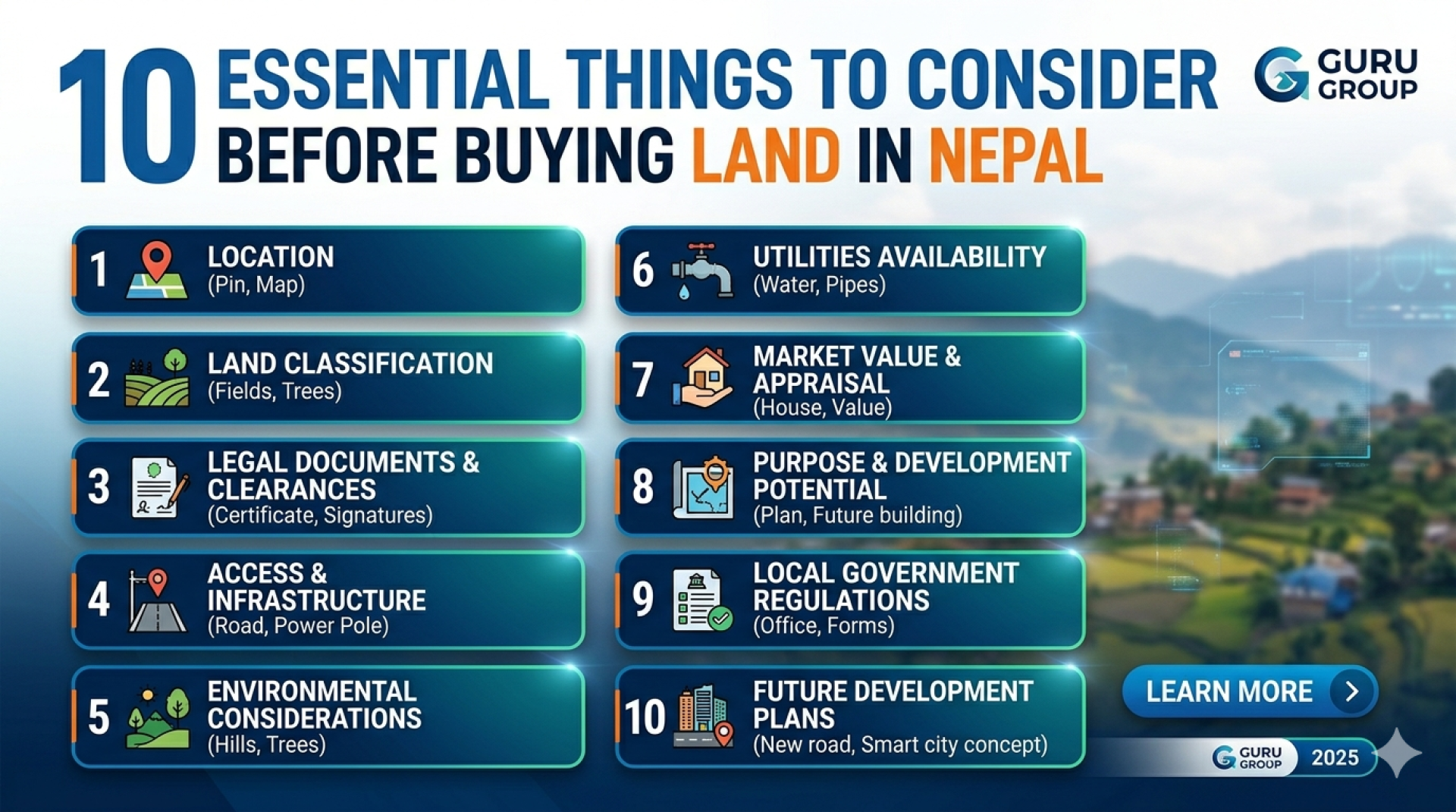
Buying land in Nepal is a powerful wealth-building opportunity — but only when approached with the right knowledge, careful due diligence, and the support of experienced professionals. The 10 considerations outlined in this guide are not just formalities; they are your financial protection and peace of mind.
Whether you are a first-time buyer or a seasoned investor, taking the time to verify documents, understand zoning, evaluate location, and assess infrastructure will ensure that your land purchase delivers lasting value for you and your family.
At Guru Group, we are committed to making your land-buying journey transparent, secure, and rewarding. Explore our Dhulikhel Paradise project and discover why hundreds of smart investors have trusted Guru Group for their real estate needs in Nepal.
📞 Ready to invest? Contact our team today for a free consultation and site visit.