



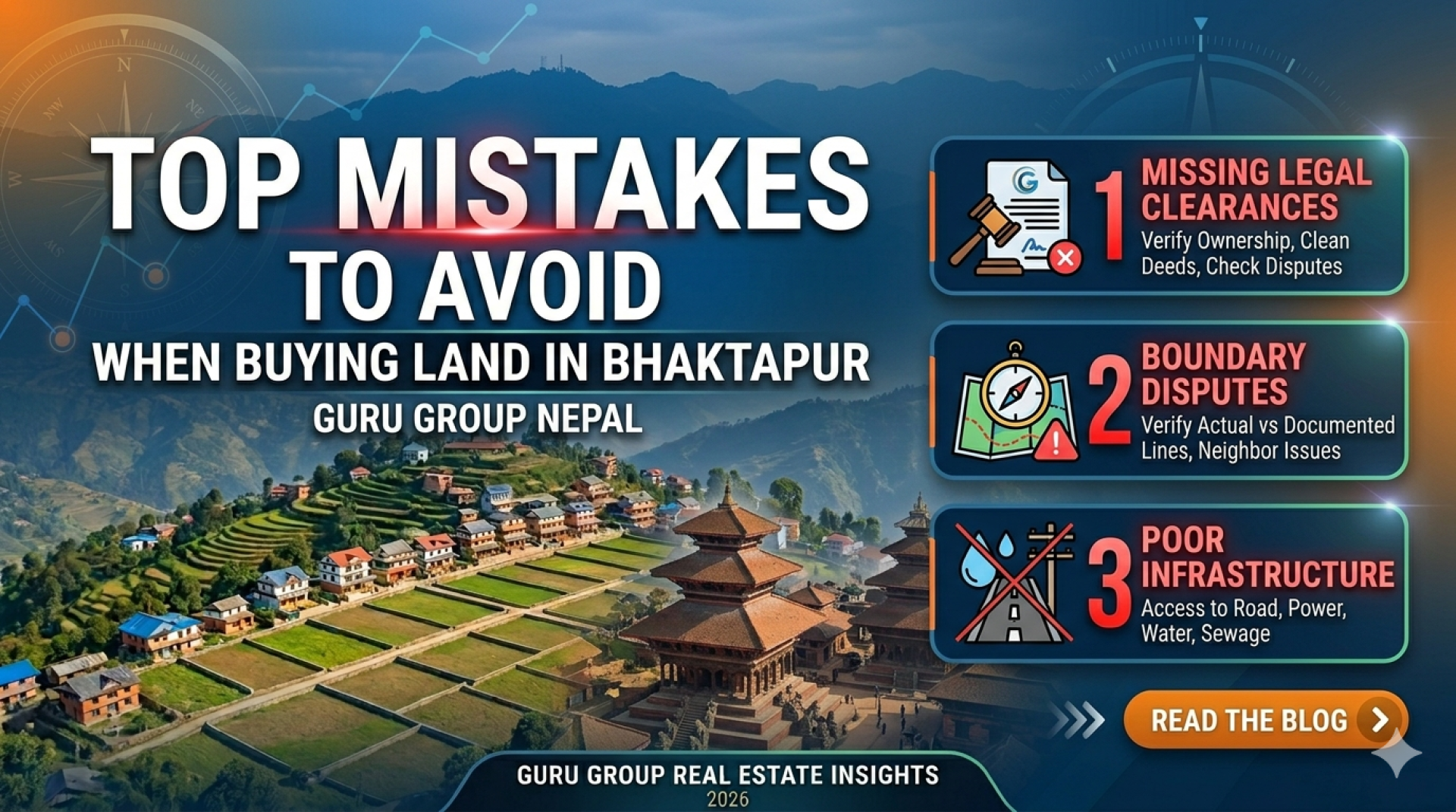
Buying land in Bhaktapur sounds like a dream — ancient temples, rich culture, and proximity to Kathmandu. But beneath the beauty lies one of Nepal's most legally complex real estate markets. One wrong step and your dream investment can become a costly, years-long nightmare.
Why Buying Land in Bhaktapur Demands Extra Caution
Bhaktapur — one of the three jewels of the Kathmandu Valley alongside Kathmandu and Lalitpur — is renowned for its extraordinary Newari architecture, UNESCO World Heritage Sites, vibrant arts scene, and tight-knit community culture. It is no surprise that many home buyers and investors are drawn to the idea of owning land in this historic city.
However, buying land in Bhaktapur is among the most complex real estate transactions in Nepal. The combination of ancient ownership structures, dense urban fabric, strict heritage conservation laws, high land prices, and limited new development land makes Bhaktapur a market where due diligence is not optional — it is absolutely critical.
Below are the 12 most critical mistakes buyers make when purchasing land in Bhaktapur — and exactly how to avoid each one. Whether you are a first-time buyer or a seasoned investor, these lessons could save you millions of rupees and years of legal headaches.
Three major heritage zones impose strict building controls on surrounding land. Many plots cannot be freely developed.
Much of Bhaktapur's land is held under traditional Newari joint-family systems — verifying sole ownership is often complicated.
Urban land in Bhaktapur is often irregularly shaped, with boundary disputes more common than in planned suburban areas.
Land prices in Bhaktapur are among the highest in the Kathmandu Valley, making overpayment an especially costly mistake.
1Ignoring Heritage Zone & Archaeological Restrictions
This is the single most dangerous mistake a land buyer can make in Bhaktapur. The city is home to three UNESCO World Heritage Sites — Bhaktapur Durbar Square, Changu Narayan Temple, and Dattatraya Square area — along with numerous protected monuments and archaeological zones maintained under Nepal's Puratatwa Vibhag (Department of Archaeology).
Nepal's Ancient Monument Preservation Act imposes strict development restrictions within 200 meters of any classified monument. If your plot falls within or near a heritage buffer zone, you may be prohibited from:
- Building any new structure at all
- Rebuilding or significantly altering existing structures
- Exceeding strict height limits (often as low as 2–3 stories)
- Using modern construction materials (steel, glass facades, etc.)
- Demolishing existing traditional structures
Even plots that appear to be outside the visual range of a temple or monument can be subject to these restrictions — always request written clarification from both the municipality and the Department of Archaeology before committing to any purchase near old Bhaktapur.
2Skipping or Rushing the Lalpurja Verification
The Lalpurja (land ownership certificate) is the foundation of any land transaction in Nepal. Yet a surprisingly large number of buyers — especially those in a hurry — either skip thorough verification or accept photocopies without cross-checking the originals at the Land Revenue Office.
In Bhaktapur, this mistake is particularly risky because:
- Land has often been subdivided multiple times through inheritance over generations, making ownership chains complex
- Traditional Guthi land (community-held land under Newari socio-religious institutions) can sometimes be fraudulently presented as privately owned
- Forged or altered Lalpurja documents do circulate in the market
- Multiple Kitta (parcel) numbers from the same original plot can cause confusion about which portion is being sold
3Not Verifying Land Use Classification & Zoning
Bhaktapur Municipality operates under a strict Land Use Master Plan that classifies every plot into specific use categories. Many buyers assume that any land they can purchase can also be built upon — this assumption is dangerously wrong in Bhaktapur.
Common land use classifications you will encounter include residential, commercial, heritage conservation, green zone (open space), and agricultural. Each comes with very different construction rights.
A plot classified under Bhaktapur's Heritage Conservation Zone or Green/Open Space Zone may have zero new construction rights, regardless of what the seller tells you. Similarly, agricultural land (Krishi Bhoomi) requires formal land-use conversion approval before any building is permitted — a process that is expensive, time-consuming, and not guaranteed in Bhaktapur's tightly regulated environment.
4Overlooking Encumbrances, Loans & Legal Disputes
One of the most financially devastating mistakes in any land purchase — and especially pronounced in Bhaktapur's dense market — is buying land that has a hidden encumbrance, active mortgage, or ongoing court dispute.
Land in Bhaktapur may have:
- A bank mortgage or microfinance loan attached that the seller conveniently fails to mention
- An active court case between co-heirs disputing the right to sell
- A government acquisition notice (Sifarish) for road widening or public infrastructure
- Unpaid land tax (Malpot) arrears that transfer to the new buyer upon registration
- A prior sale agreement (Baikalpatra) with another party that hasn't been disclosed
5Ignoring Road Access & Right of Way Documentation
In densely built Bhaktapur, road access is far from guaranteed — even for plots that appear accessible on foot. Many plots in inner Bhaktapur lanes have no formal legal road access document, relying entirely on traditional pathways through neighboring properties that can be blocked at any time.
Without formal, documented road access, you will almost certainly be unable to obtain a building permit from Bhaktapur Municipality. Most local regulations require a minimum road width (typically 6 meters for residential construction permits) — and many inner-city lanes in Bhaktapur do not meet this standard.
Always verify:
- Whether the plot has frontage on a public road maintained by the municipality
- If access is via a private lane, that a legally registered Right of Way deed exists at the Land Revenue Office
- The physical width of the access road and whether it meets Bhaktapur Municipality's permit requirements
- Whether any proposed road widening plans will affect the plot's access or frontage dimensions
6Overpaying Due to Poor Price Research
Bhaktapur's land market commands some of the highest prices in the Kathmandu Valley. The emotional appeal of heritage location, proximity to the capital, and limited supply can cause buyers to significantly overpay — especially first-time buyers or NRNs unfamiliar with local market rates.
Land prices in Bhaktapur vary enormously by specific location, ranging from NPR 15 lakh to NPR 80 lakh or more per Aana in prime areas. A 20–30% overpayment on a plot priced at NPR 50 lakh per Aana translates to NPR 10–15 lakh in losses per Aana — compounded over multiple Aanas of land.
| Price Research Step | ❌ Common Mistake | ✅ Right Approach |
|---|---|---|
| Government Value Reference | Relying only on Sarkaari Moolya as fair price | Use it as a floor; cross-check real market transactions |
| Market Comparison | Accepting seller's asking price without negotiation | Research 3–5 comparable transactions in the same ward |
| Agent Valuation | Trusting a single agent who represents the seller | Get independent valuations from 2–3 agents with no seller relationship |
| Premium Factors | Paying full heritage-view premium for restricted plots | Discount price appropriately for any building restrictions |
| Total Acquisition Cost | Budgeting only for the land price | Add stamp duty (4–5%), registration, lawyer, and agent fees |
7Relying on Verbal Agreements or Informal Commitments
In Nepal's property market — and especially in Bhaktapur's traditional community context — it is not uncommon for deals to begin with verbal agreements, handshakes, or informal Baikalpatra (advance agreement) letters. None of these have legal standing in Nepal's property law unless properly notarized and registered.
Buyers who pay advance amounts based on verbal promises risk losing that money entirely if the seller backs out, faces family objections, or transfers the land to another party. Similarly, verbal promises about road access, utility connections, or plot boundaries are completely unenforceable in a dispute.
8Proceeding Without a Qualified Real Estate Lawyer
Given Bhaktapur's uniquely complex combination of heritage law, ancestral ownership structures, dense urban layout, and high prices, attempting to navigate a land purchase here without professional legal assistance is one of the highest-risk decisions a buyer can make.
Many buyers try to save money by skipping legal fees — only to spend ten times more in subsequent dispute resolution costs, court fees, and financial losses. A qualified real estate lawyer in Nepal will typically charge between NPR 15,000 and NPR 50,000 for a complete land transaction review — an investment that can save you millions.
A good real estate lawyer will:
- Conduct a complete title search at the Land Revenue Office and District Court
- Review and draft the Sale Agreement (Baikalpatra) and Transfer Deed (Rajinama)
- Verify all co-owner consents and inheritance documentation
- Check for heritage zone restrictions and municipality building permit eligibility
- Confirm encumbrance-free status and tax clearance
- Oversee the registration process and stamp duty payment
9Missing Co-owner Consent & Inheritance Documentation
This mistake is especially prevalent in Bhaktapur, where traditional Newari families have historically held land under joint family systems, and inheritance has often not been formally registered at each generational transfer. If even one co-owner — present or absent, domestic or abroad — has not given valid legal consent to the sale, the entire transaction can be invalidated by a court after you have completed the purchase.
Warning signs that co-owner issues may be present:
- The seller mentions siblings, cousins, or other relatives who are "abroad" or "not involved"
- The land has been inherited but no formal partition (Anshabanda) has been registered
- The seller seems unwilling to produce family tree documentation or co-heir consent letters
- The Lalpurja lists multiple names but only one person is present for the deal
10Buying Without a Physical Site Inspection & Independent Survey
In today's digital age, some buyers make preliminary decisions based on photos, videos, or location maps — and skip thorough physical site visits. In Bhaktapur's irregular urban geography, this can be a costly shortcut.
During physical inspection and independent survey, you may discover:
- The actual plot size is smaller than stated in the Lalpurja due to historical encroachment by neighbors
- The site has subsidence issues, marshy ground, or proximity to drainage channels that make construction expensive or impossible
- A neighbor's wall or structure has encroached on the boundary of the plot being sold
- The "road access" is a narrow private alley that does not meet building permit width requirements
- The view or amenity feature the seller emphasized (a view, a garden) is actually on a neighboring plot
- The land is in a low-lying area prone to seasonal waterlogging
11Not Accounting for Infrastructure Gaps
Bhaktapur's older urban areas — particularly within the heritage core — have aging and often inadequate water supply, drainage, and electricity infrastructure. Some areas rely on traditional stone spout (dhunge dhara) water systems, while others face chronic water shortage and drainage overflow during monsoon.
Before completing any purchase, verify:
- Whether the plot has an active or easily obtainable NEA electricity connection
- The source and reliability of water supply — municipal, private water tanker, or traditional spout
- Drainage adequacy, especially for plots in low-lying lanes or near rivers
- Internet and telecom connectivity for the specific lane or area
12Rushing the Transaction Under Seller Pressure
High-pressure selling tactics are not uncommon in competitive land markets. Sellers may claim "another buyer is ready," "the price is going up next week," or "this is the last plot available" to push buyers into rushing their decision. Rushing a land purchase in Bhaktapur is one of the fastest ways to make an expensive mistake.
A legitimate seller with clean documentation, clear title, and fair pricing will never pressure you to skip due diligence. If you feel rushed, that pressure itself is a warning sign worth taking seriously.
Tired of Bhaktapur's Complexities? Consider Dhulikhel Paradise
Every mistake on this list is eliminated when you buy a plot at Dhulikhel Paradise — a fully planned, government-approved, legally clean land development by Guru Group in the scenic hills of Dhulikhel, just 30 km from Kathmandu.
While Bhaktapur's land market offers heritage charm, it comes packaged with serious legal complexity, strict heritage restrictions, very high prices, and limited new construction opportunities. Many buyers — after months of frustrating due diligence — conclude that the risk-to-reward ratio simply does not justify the premium.
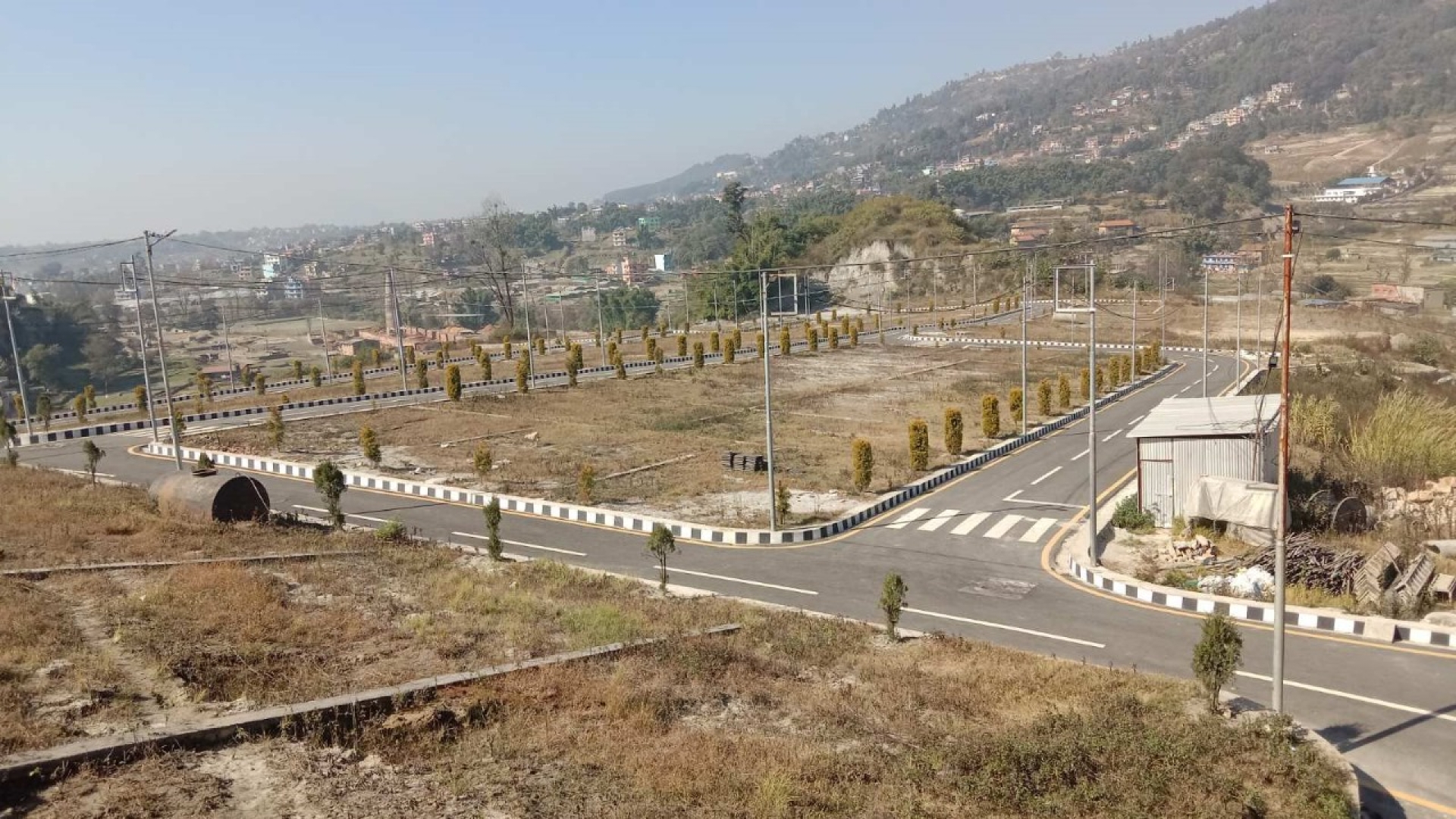
Dhulikhel Paradise by Guru Group offers a compelling alternative: premium planned residential plots in Dhulikhel, Kavrepalanchok, featuring panoramic Himalayan views, clean mountain air, excellent road connectivity via Arniko Highway, and — critically — none of the legal complexities that make Bhaktapur so challenging. Every plot comes with clear individual Lalpurja, no encumbrances, no heritage restrictions, no co-ownership complications, and full infrastructure already in place.
🏔 Dhulikhel, Kavrepalanchok · Guru Group Real Estate · gurugroup.com.np
Explore Dhulikhel Paradise →❓Frequently Asked Questions
✅ Bhaktapur Land Buyer's Complete Checklist
- Confirmed plot is NOT within a UNESCO Heritage or archaeological buffer zone
- Verified original Lalpurja at Bhaktapur Land Revenue Office (Malpot Karyalay)
- Confirmed land is not Guthi, institutional, or government-restricted land
- Obtained Encumbrance Certificate confirming no mortgage or legal claims
- Verified land-use classification with Bhaktapur Municipality in writing
- Confirmed building permit eligibility and applicable construction restrictions
- Confirmed legal, permanent road access meeting municipality width requirements
- Conducted independent physical survey with licensed surveyor (Napi Karmachari)
- Verified all co-owners have provided notarized, registered sale consent
- Reviewed all inheritance documentation and partition (Anshabanda) records
- Confirmed all pending land tax (Malpot) arrears cleared by seller
- Obtained municipality confirmation of road widening or acquisition plans
- Signed formal written Sale Agreement (Baikalpatra) prepared by a lawyer
- Engaged a qualified real estate lawyer for complete transaction review
- Visited the site multiple times in person before final decision
- Compared price with 3+ comparable plots in the same area of Bhaktapur
Final Word: Bhaktapur Land Can Be a Great Investment — If Done Right
Bhaktapur is a magnificent city with genuine real estate appeal — strong heritage tourism, proximity to Kathmandu, and a culturally rich environment. For the right buyer who does thorough due diligence and understands the legal landscape, purchasing land in Bhaktapur can be a rewarding long-term investment.
But that success demands patience, professional guidance, and an absolute refusal to cut corners on legal verification, heritage zone checks, physical surveys, and document review. The twelve mistakes outlined in this guide represent the most common — and most costly — pitfalls in Bhaktapur's real estate market. Avoiding even one of them could save you lakhs of rupees.
And if Bhaktapur's complexity feels like too much to navigate, remember that Dhulikhel Paradise by Guru Group offers a transparent, legally clean, infrastructure-ready alternative in the scenic hills of Dhulikhel — all the reward of a smart Nepal land investment, without any of the complications.
📞 Need expert guidance? Visit gurugroup.com.np or call our real estate team today for a free consultation on buying land anywhere in Nepal.